Thursday, 5 January 2012

Future Games, Future Animation

Games and animation have come a long way since they first appeared. But, what lies in store for them in the future?
Consoles, computers and screens are getting bigger and better each day, so, games and animations are going to evolve along side them, but, what form will they take?

Visuals will of course be enhanced with the possible crossing of the uncanny valley. So one of the possible enhancement will probably be the achievement in photorealism in animations and in games. Photorealism in animation may not serve any other purpose than technical achievement (since we can use camera to film live action footage instead of spending time animating and composing sequences), with maybe the added bonus that one day photorealistic animation might be cheaper than live action. Games on the other hand would greatly benefit from photorealism, bringing the player closer to total submergence.

New technology such as motion controllers, cameras with motion tracking systems and 3D screens are already widely used. In time I believe they will be perfected so that they become the "norm". Taking them a step further, we might see 3D headgear or 3D glasses that allow people to feel like they are walking through the gaming environment. Prototypes already exist but the finished product is a long way away.

Gloves fitted with motion capture systems as well as special controls to immerse the player fully might make him or her feel like they are actually wielding the sword/dealing blows/ casting spells or interacting with characters or objects from the game (for example: thermal controls that make the gloves cold could make the wearer feel like they are trapped in a blizzard; vibrations or small electric shocks will make them feel like they are touching things, casting magic, hitting things, etc). The gloves, combined with a 3D visor would help the gamer feel submerged.The technology for these things already exist, so it's just a matter of time. But, what about sound? Smell? Taste?

Taking things a step further I can imagine a cylindrical room/chamber, small enough to fit in any room of your house/apartment, but big enough for one or two fully grown adults to fit in with enough oom for movement. The walls would act as a screen displaying a 360 degree 3D view of the gaming environment. Scents could then be used inside the chamber (pine, flower and grass for woods for example). A surround-sound system would solve the noise problem, with the room canceling out all external sounds. Taste would be difficult to replicate, but, since most games do not require you to taste things in-game, this wouldn't be a problem. But if need be, one could use sprays with different tastes:

The gamer would theoretically be able to interact with the game as if he is in the real world. Of course, the room would have to be ventilated so that you won't die from lack of oxygen or from pungent odours (from the scents mixing). Then there's also the fact that the gamer would have to remain standing for long periods of time thus he'd become fatigued. Though that would force the gamer to exercise (on of the downsides of gaming most parents seem to point out). But then, we'd eliminate the need to go outside and exercise. In a Second Life scenario people could end up living as their game counterparts, interacting in an ideal world, but that again could go both ways. As a means of entertainment it's ok but some people will fo over board and will refuse to go outside and interact with the real world ( some people do that now with our "limited" technology).

As far as animation goes, an open ended or interactive narrative might be the future. Using the same "game room"/ "screen room" we can imerge ourselves and interact with the animation. 
Perhaps different screens that can be bended into different shapes/changed and that reaction to our motions might exist. It the screen would be made from a pliable and mouldable material we could stretch it out, turn in into a ball, rip pieces of it. If we have an animation of a fish bowl, we can flatten in (the water pours out) we can make it a ball (we make it back into a bowl), we rip pieces apart (separating the fishes). 

So, in 5 years I think we'll have even better motion capture technology (maybe gloves so that it will feel less clunky than a controller), or better motion capturing cameras (a step forward from the Kinect).
In 20 years we'll probably have photorealism and perhaps good 3D head gear or a 360 degree room. Motion capture cameras could be used for the "game room" but we'd still need the gloves to be able to replicate the sense of touch.

Games and animation will probably go in a very different direction from what we have at the moment, as people want to experiment newer things so much so that the new experience would be more important than the actual finished product, so we'll just have to wait and find out where human resourcefulness and imagination will lead us.

The Hero's Journey

The Hero's Journey, or the monomyth refers to a basic pattern that is supposedly found in narratives from all over the world. Thus, one should be able, without fail, to create a compelling story using this structure. But, is this the case?

Joseph Campbell (the man who coined the term) argues that due to a psychological undercurrent specific to all humans, we are "hot-wired" to structure storied using the following 17 stages:


  •  Departure
    • The Call to Adventure
    • Refusal of the Call
    • Supernatural Aid
    • The Crossing of the First Threshold
    • Belly of The Whale
  • Initiation
    • The Road of Trials
    • The Meeting With the Goddess
    • Woman as Temptress
    • Atonement with the Father
    • Apotheosis
    • The Ultimate Boon
  • Return
    • Refusal of the Return
    • The Magic Flight
    • Rescue from Without
    • The Crossing of the Return Threshold
    • Master of Two Worlds
    • Freedom to Live

This structure has since been reformulated several times by several different people. Nowadays it's used as a structure in Hollywood movies (scripts that don't have this structure -Syd Field's Paradigm-are rejected).
One of the most well know and successful examples of using this structure to write an award winning movies is George Lucas' "Star Wars". Lucas has admitted using this structure in the book "Joseph Campbell: A Fire in the Mind" (Larsen and Larsen, 2002, pages 541-543).
This structure can also be applied to a variety of movies: "Godfather" , "The King's Speech", all of the "Harry Potter" movies, "Marly and Me", "Casablanca".
I believe that, because of the vagueness of the stages almost any movie (if not all of them) can be forced into this mould. This has given rise to criticism from various people stating that, by using the monomyth one loses all originality. Cliches thus become widely used and individuality is lost. Others, such as David Brin, claim that the monomyth was born out of cross-cultural similarities between cultures and was mostly enforced by kings and priest to justify tyranny. He points to science fiction as an antithesis to Campbell's monomyth (how valid this claim is is a point of discussion).


The monomyth works mainly because we as a species have defined what a story is (Aristotle is one of the first to try to give a structure for stories). Whether this is because of some deep rooted psychological reason or because of a natural and logical development of the story structure. There will always be people who claim to have a different set of rules and this is how it should be. Storytelling (like all art forms) is an every growing, ever changing process that will undoubtedly take on a myriad of different forms for as long as humans shall exist, neither being better or worse than the other, just different.

Storytelling

Storytelling - the conveying of events thorough sounds, images and words ofter using embellishment or improvisation. Stories have been used in every culture as a means to insill moral values, as entertainment, for educational purposes and to preserve cultural heritage.
Some of the crucial elements of storytelling are: characters, plot and narrative point of view.

People have used a variety of medium and ways of storytelling throughout history, everything from rock art (pictures drawn or carved on/in rock), sand, leaves and tree branches, tattooing (showing the story of the tribe, or the clan- used even nowadays by Yakuza members), singing, oral narrative, dance, then gradually transitioned to written language (when the first alphabets were invented), first on rocks and leaves then on paper. Nowadays people make use of video cameras, computers, recorders, video games, animation, film making, and anything in-between to tell a story. We even have a wider view on what constitutes a story. Apart from the traditional forms like legends, fables, fairytales, mythology, plays etc. we also have political commentaries, personal narratives ( diaries, blogs), etc.
One of the first attempts at examining the structure of various narratives was made by Aristotle in his work "Poetics". Through it he attempts to define structures for certain types on narratives (poetry, tragedy and comedy). He also set the basis for a story- what is should consist of: Beginning, Middle and End.

One of the major differences between traditional storytelling and modern storytelling is interactivity. The ability to change the story according to the reader/ viewers whims has taked storytelling to a different level. Games allow us to interact with the story and leave our imprint on it, even though the basic story and premise remain unchanged. And certain games such as Second Life give you the opportunity to create your own story and interact with other people (and their stories) thus giving birth to yet another new type of storytelling, where two stories merge to create a third, new one, where they can be seen as different stories or one story with two staring points. Yet, no matter what hybrids may arrise the main building blocks of story telling must still remain. Given to much freedom and ambiguity creates either a bad story(with no structure) or a bland story ( so structures and concise that it leaves nothing to the imagination - narratology is, after all, an art form).

Games seem to be the best bet for original storytelling. The interactivity mixed with traditional storytelling (oral and visual) make games the most versatile and most groundbreaking way of storytelling, and only time will tell where it will lead us.
Player Types

Based on a paper by Richard Bartle, the Bartle Test of Gamer Psychology is a series of questions designed to categorise players into certain groups: Achievers, Explorers, Socialisers and Killers. It has become so well known that video games designers have used it to determine what type of games they should make based on a particular target audience.

While several people have questioned the validity of this test (the idea that people can be grouped into only 4 disting groups is a bit of a stretch), the main idea of the test ( organising player types and preferences) is valid. While various sub-types may appear (mixes between types -which leads me to believe that there are more than the 4 main types and that the mixes should become types as well), the test is a good framework to start from.

After taking the Bartle Test I found out that I am an Explorer/ Achiever. So, judging from the graph bellow, I'm interested with interacting with the environment as well as acting on it and changing it to my needs and desires.


I had a vague notion that I might end up in these categories. I tend to like exploring the games (getting into the story, getting to know the characters, learning about how to best use the various pieces of the games, whether those are moves, various weapons or artifacts, or maybe just cheats that will ultimately enable me to better enjoy the game- although cheating as a way of increasing the gaming pleasure is a different topic altogether), so I am a typical Explorer. On the other hand I do get a sense os satisfaction from high scores and winning, so again, I have typical Achiever traits. But given the right incentive, I could easily fall into the other two categories: Socialiser or Killer, depending on my mood or my objective.

I believe that most people tend to go through all of the types at various points either in the game or maybe even in their lives. How much your real persona influences the game persona is a contention point. Although I'm sure that our personality plays a part in how we play games, the reason we play games is to experience a different reality, and that usually includes a different persona. You play a game because you get a sense of freedom you wouldn't experience in real life (you wouldn't shoot someone in the head like you so freely and happily do in games such as Call of Duty, or steal a car like in Grand Theft Auto, you certainly  wouldn't try to use spells or weapons to defeat wolfs or bear in real life as you do in Skyrim). Some people create entirely different personas and life in a sort of wish fulfillment through games such as Second Life or World of Warcraft.
You could say that people who choose to create a different game persona are still creating it based on a player type (the character they create may be a sorcerer who spends time learning spells, thus he or she can be termed an Explorer, or maybe the character is a worrier only interested in killing and maiming opponents , thus being a Killer), but everyone needs different things at different times and to try to force a person into a mould based on a single game type (MMORPG), or a certain time frame, I think, is a mistake. Again, the premise is good, but the detailes need to be sorted out to avoid muddling.

In the end, I think a successul game should have something to offer each player type, because in concentrating on just one you eliminate a huge market of potential players, as well as leading to a dwindling of all the other players (Mr. Bartle shows in his thesis how all player types are interconnected, each one "feeding" on the other, so a balance is always needed)

Animation and Computer Games

They're both part of digital media, there have been a number of transitions between them ( computer games based on tv shows, movies based of games, etc). Computer games use animation for cut scenes. So they are in some cases linked, but, what are the differences between them?

Computer games and animation are both immersive, but, in different ways. When you play a game you are usually given a wide range of options to choose from that directly effect either the game play or in some cases the game. With animation, on the other hand, one doesn't have the option of changing any part of it, yet this doesn't take away from the enjoyment (as long as we're referring to the viewer - or player in case of a game - and not the creator who experiences both immersion at certain parts of the creative process as well as full control of the mediums). Therefore, both allow the viewer to interact and become part of the world the game or animation are potrating, but in various degrees or ways. Games tend to have a more physical approach to immersion, whereas animation tends to be geared towards the imagination and inner world of the viewer (that is not to say that video games don't use the same psychological immersion techniques).

Another point to consider is the quality of the animation for each of them. Animation for a feature film or a series is usually high quality, animators having the enough time to focus on it and few software limitations to worry about. With video games, on the other hand, although animation is usually one of the focal points of the game, many other things have to be done in parallel. Game mechanics, level designs, programming,environment interactivity time constraints all contribute to the animation quality. But, most importantly, software limitation is the one that brings down the animation in games. Based on the console the games is geared at, the memory one has is limited. The modelling has to be simple (with simple rigs), which usually leads to clunky animations. The quality of the characters (facial animation, clothes, hair) is usually subpar when compared to an animated movie because of the same reason. The more complex the characters and backgrounds, the greater te lag in render playback. Yet, consoles are even evolving and with their evolution comes more memory and more space within which animators can create better and better animations.

I feel that, although they are two different digital medias, and though they will always retain separate undiluted forms, they will at some point in the future mix together to form a completely new digital media. Whether it will be an animation that will allow you to hand pick certain actions the characters take so as to lead them towards different endings, or a game where the animation will reach the same quality as in features films, maybe even one that allows you to "direct" you own animation/game by giving you options for camera positioning, character and selection, ability to alter elements in the game (whether they are character or background objects or even settings), while still retaining the "feel" or basic story of the game. Only time will tell where this two medias will head and how they will merge.

The Uncanny Valley

The Uncanny Valley: has it been crossed yet?

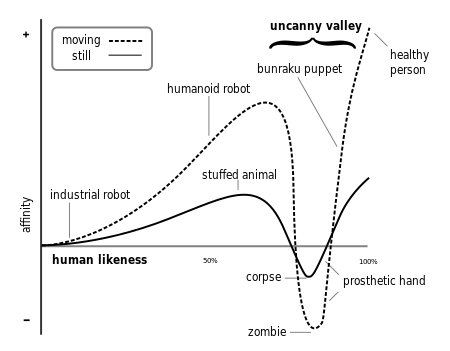
What is the uncanny Valley? Wikipedia says it is: "(...) a hypothesis in the field of robotics and 3D computer animation, which holds that when human replicas look and act almost, but not perfectly, like actual human beings, it causes a response of revulsion among human observers. The "valley" in question is a dip in a proposed graph of the positivity of human reaction as a function of a robot's human likeness."


First coined by professor Masahiro Mori in 1970, mankind has since tried to create robots and 3d characters that cross this so-called valley. These attempts have been more or less successful, as we shall see. Yet, can the Valley be crossed? Although all people have a basic psychological archetypical structure, one has to take into consideration the subjective nature of people. People perceives things in a purely subjective and original way, entirely different from one another, and these perceptions can shape the way one perceives the Uncanny Valley. So, what one perceives as disturbing, another might perceive as funny, endearing or interesting, without feeling the least bit of repulsion. 


As we can see from the above graph, the more human like something is the more repulsed we feel by it,that is, until it crosses over to a real human, at which point we become comfortable again. As we can see, people seem to be irked by the lack of life in the puppets/zombies/3d characters etc. So it's not only a problem of hoe life like something looks but also how life like something comes across/ feels to us. Again, this feeling will be different on a case by case basis. Human perception is formed through experience, so, when something doesn't match our day to day experience (i.e. a 3d character doesn't move in the same way we know humans are supposed to move), the uncanny valley appears. 


A few theories on why the valley exists have been proposed:
a. Mate selection: wherein we are biologically designed to reject potential mates that we deem subpar (i.e. infertile) - we are attuned to notice imperfections
b. Mortality salience: the way the "uncanny" robot moves reminds us of our own mortality, of our own transient life .It plays on our fear of death, our fear of not being unique and being easy to replace and in some situations of losing control of our body (jerky movements, weird facial expressions reminiscent of facial nerve paralysis)
c.Pathogen avoidance: The visual anomalies and defects signal to us that the human like creature might carry a desease, thus we feel aversion as a means of signalling that we should avoid it.
d. Sorites paradoxes: We find it difficult to discern when the robot stop becoming a robot (non human) and bomes human.
e. Violation of human norms: a robot which has enough non-human characteristics will be judged as a robot, but, a robot with enough human-lika characteristics to do a passable job as a human shall be judged as a human ( therefore the defects are highly magnified)
f. Religious constructions of human identity: by acknowledging a human like robot we acknowledge that there is no such thing as human uniqueness. This causes existential anxiety, wherein we are reminded of our mortality and our ageing (things which humans then to attributet to others except oneself)


Here are a few examples of the Uncanny Valley in action: 


In the end the uncanny valley hasn't been crossed yet but we are on the right track, and, at the rate at which electronics are progressing it is really just a matter of time until someone manages to cross it.

Sunday, 8 May 2011

Experimental Animation


During the Avant- Garde and Abstract Art era of film making a new type of animation, paralleling these movements, emerged. Standing as a contrast to "commercial" animation, this type of animation sought to explore new techniques , use animation as a means of artistic self expresion, and create new ways of animating.
Experimental animation is usually done by an individual as opposed to a studio, and is usually produced with much smaller budgets than other animations. However, this is not an impediment  but, on the contrary, it seems to help with the experimental nature of this art form by forcing the creator to think outside of the box. Although not usually not commercially successful, experimental animations have nonetheless left an imprint on mainstream animation, influencing such works as Disney's "Fantasia".


Hans Richter's "Rhythm. 23" from 1923:


Andrzej Pawlowski's "Here and There" (1957)


Len Lye's "Free Radicals" (1958):


Oskar Fischinger's "Danse Macabre":


Normal McLaren's "Dots" (1940):


Mary Ellen Bute's "Synchromy No. 4":


Walter Ruttman's "Opus I" :


As we can see, experimental animators play with form, colors, textures, rhythm, combine mediums, use controversial images and rarely use storytelling, all in an attempt to illicit emotion from the viewer.
While not a fan of experimental or abstract animation, I find some of them quite interesting and inspirational. The raw emotions and images one derives form viewing such animations are a great way of  getting inspiration for any art form.

United Productions of America


Following the Disney animator's strike in 1941 (where many animators left the studio as a result of the slow formation of The Screen Cartoonist Guild) John Hubley (a former Disney employee) formed United Productions of America (UPA) was formed. Most of the animators that left Disney joined this new studio as a way of protesting agains Disney and because of the need of finding a new job.
UPA pioneered a new approach to animation- "limited animation", where the aim was to lower production costs by having fewer than 25 frames per second, reusing stock animation, animating only certain parts of characters (like arms , legs , or mouths) and paying little attention to perpective and realism.
The animators experimented with the style and developed abstract and symbolic animations that focused more on content rather than form.
Chuck Jones was one of the first animators to try limited animation in the animated short, "The Dover Boys of Pimento University":


"Gerald McBoing Boing" was the first of UPA's successes. It won an Academy Award in 1950:


Mr. Magoo was one of the most beloved stars from UPA:


The revolutionary new way of animating that was started UPA has forever transformed the world of animation. Most 2D animations nowadays using limited animation.

Non-Disney Cartoon Stars - Part 2- Warner Brothers Cartoons


Warner Brothers have created some of the most memorable, exciting and funny cartoon characters to date.

As opposed to the "cute, typical, conventional characters of Fleicher and Disney, WB created screwball characters with strong vocals (mostly done by Mel Blanc). They also invented "click tracks" which used musical puns to match the action on the screen.


Porky Pig, created by Fritz Frelang, was one the first stars. A huge hit, his most famous characteristic was his stuttering. His has been animated by Tex AVery and Bob Clampett. Mel Blanc provided the voice for most of his appearances.


Bugs Bunny, the second most popular cartoon character in the world, was originally designed by Cal Danton and modified by Tex Avery, and later by Robert McKimson.
He first appeared in "Porky's Hare Hunt" in 1938:


The first short in which he was the title character was: "A Wild Hare" in 1940:


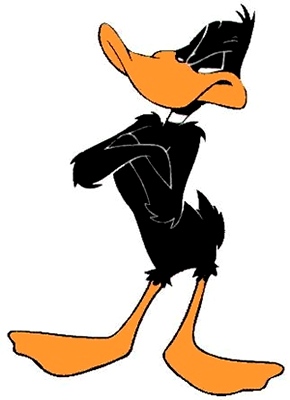
Daffy Duck, bearing a slight resemblance to Disney's Donald Duck, made his debute in 1937 in the short " Porky's Duck Hunt":


Warner Brother's characters were sneaky, devious, intelligent, had snappy comebacks , had strong designs and appeared in each other's cartoons forming a close knit family. They have been so popular that they have appeared in two live action movies, have a vast array of merchandise , from figurines and plush toys to t-shirts and stationary.

Warner Brother's characters are some of the funniest, zaniest I have even seen. They have great personalities (the monotonous Marvin the Martian, the short tempered Yosemite Sam, the slow minded Elmer Fudd , the unlucky Wile E. Coyote) and are beautifully animated.

Non-Disney Cartoon Stars - Part 1


Although Disney had some of the most popular characters, there were many more cartoon stars in Hollywood.

Winsor Mckay's Gertie the Dinosaur was one of the first animated stars of her day:


Otto Messmer 's Felix the Cat was another star:


Max Fleischer created several stars.
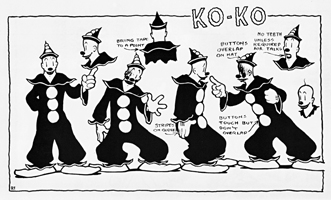
Koko the Clown:


Betty Boop - a sex symbol in her own wright:


And Popeye:


These characters seem to be aimed at a more mature audience. Betty Boop was modeled after the "It girl" of those times, Clara Bow, and Popeye was a pipe smoking sailor that regularly got into fights.
Their popularity still holds to this day, with dozens of animated shorts, comic books, figurines and games created. Their timeless appeal demonstrated that a well designed, well rounded character bypasses age, race or sex.

Disney's Donald Duck


This anthrophomorphic duck, know for his bad temper and semi-intelligible speech pattern, has been a huge success with the public, being ranked 3rd best cartoon character of all time (right after Mickey Mouse and Bugs Bunny).

He first appeared in "The Little Wise Hen" in 1934:


His first bouts of anger were portrayed in the Mickey Mouse cartoon " Orphans Benefit" :


He continued to feature in Mickey Mouse cartoons, his first headliner short coming in 1937 with Ben Sharpsteen's cartoon "Don Donald" :


In 1942, Disney won an Academy Award for " Der Fuehrer's Face", a Donald propaganda cartoon:


Donald's popularity spurred the creation of associated characters such as Donald's nephews.
Donald Duck is more popular than Mickey Mouse in Scandinavian countries. The problematic of his morality has even been debated in Finland. Some citing his lack of pants and him living with Daisy, while not being married, as being "too bourgeois" while others regard him as a "genuine proletarian.

His design has remained mostly the same as time's gone by.
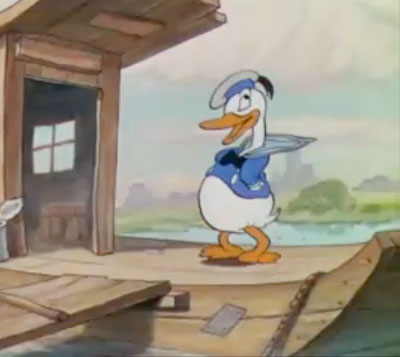
his original design :


had him wearing his trademark cap, sailor suit and color palette.


His subsequent design:


retained the same clothes, but made him "cuter" with larger eyes, a slimmer body, a rounder head and bigger feet.

Donald is one of the most popular Disney character, and , in my opinion, one of the most lovable ones. His character flaws and quirky personality make him more believable and likeable and his lack of pants is hilarious.

Disney's Mickey Mouse


This Disney mascot has appeared in countless Disney shorts, films, and recently a critically appraised video game.
Mickey was born as a replacement for Oswald the lucky Rabbit, a character created by Disney studio for Charles Mintz, but over whom Walt Disney no longer held any copy rights. The inspiration for Mickey came from Walt's pet mouse that he owned when he lived on a farm as a boy. Originally names Mortimer Mouse, the name would soon be dropped ( at Lillian, Disney's wife, request) and Mickey Mouse would be adopted.
 The first short in which Mickey starred was "Plane Crazy" in 1928:


The first Mickey Mouse that used sound was "Steamboat Willie" in 1928:


"The Band Concert" 1935:


Mickey Mouse became so famous that Mickey Mouse Clubs were popular in cinemas. The financial success that came form this popularity would be the basis of Disney's empire.

Mickey's design has changed over the years.
The original version lacked pupils, gloves (to help distinguish hands from the body ), a stodgier appearance and smaller ears.


The "Fantasia" version gave him pupils, a caucasian colored face, pupils, and a pear -shaped body:


In " The Little Whirlwind", Mickey lost his tail, his ears became more realistic and changed perspective and hw lost his trademark pants:


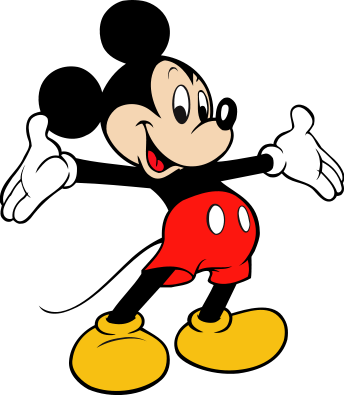
The design used nowadays features the original red pants, large eyes, round head and round ears that face the same direction no matter the perspective used.


 The ears have even become a symbol of Disney Studios.


Mickey Mouse has become such a cultural icon that he is used as a sign of protest in votes where a "None of the Above" choice is not present, electors opting to write Mickey's name as a way of protesting.
Mickey is the most recognisable character in America.
Because of the fact that he has become a symbol of Disney and America, Mickey is ofter parodied or regarded with hatred by anti-American satirists.
In 1935 Romanian authorities banned Mickey Mouse films in cinemas out of fears that children would get scared at seeing a 10 foot mouse on screen.
As we can see, Mickey Mouse is a symbol, a cartoon character people love and love to hate. Personally I paid very little interest in Mickey Mouse as a child, preferring Donald Duck's antics to Mickey's high pitched voice and annoying laugh. Still, I respect his simple design and world wide appeal and recognise his value to the world of animation.

"Snow White and the Seven Dwarfs" -1937

        Based on a fairy tale by the Brothers Grimm, this Disney feature animation is still regarded as one of the best examples of traditional animation. A great risk for Disney Studios, this animation, which could have been a commercial flop, was the one that cemented the studio as the leading practitioner of animation in the world. To this day it is looked upon animators and viewers alike as a master piece.
      Though it stays mostly true to the fairy tale, a few differences can be seen:
     - the absence of the biological mother; the film only depicts the stepmother - she serves as a contrast to Snow White : Good vs. Evil


The stepmother from "Snow White"


  - the absence of the three gifts from the witch. Only the poisoned apple is use. This was because of o need to downgrade the importance of the dwarfs, who saved Snow White from the first two gifts in the fairy tale.


Apple scene in French.


- Snow white wakes up after the prince kisses her. In the original version, she wakes up when the piece is apple is dislodged from her throat. This scene was used to accentuate the idea of true love that never dies.


Kiss scene.


- the step mother's demise. In the fairy tale she is confronted by Snow White and made to wear deadly hot iron shoes. This was changed to her folling of a cliff in the movie. This change was put in use to downplay the violence of the original scene.


The animators that worked on the film were: Frank Thomas, Dick Lundy, Arthur Babbitt, Eric Larson, Milton Kahl, Robert Stokes, James Algar, Al Eugster, Cy Young, Joshua Meador, Ugo D'Orsi, George Rowley, Les Clark, Fred Spencer, Bill Roberts, Bernard Garbutt, Grim Natwick, Jack Campbell, Marvin Woodward, James Culhane, Stan Quackenbush, Ward Kimball, Woolie Reitherman, Robert Martsch.


Even though the film was a huge succes, Walt Disney had a hard time getting it of the ground. The initial budget of 250 000 $ ended up being 1, 488,422.75 $. 
A lot of rewriting went in to the pre-production. The writers focused on gags for the dwarfs, tried to incorporate all the three gifts of the original story and the price originally would have been more of a stooge in the first drafts.


As far as cinematic influences go , films such as "Nosferatu", "The Cabinet of Dr. Calligari" and "Dr. Jekyll and Mr. Hyde" were recommended by Disney to his staff.


"Nosferatu" -1922


Although a seemingly impossible task to undertake, the feature film was a huge commercial and critical succes, receiving a standing ovation form a star-studded audience and receiving an honorary "Academy Award".
This success led to Disney producing many other feature films that have pioneered animation and shaped it into what it is today, inspiring millions.

Early Sound in Animation

The first examples of silent films usually had a live band accompanying them.
One type of silent film that used this was japanese benshi films.


Example of benshi film with modern "dubbing".


Edison invented the Kinetophone in 2895 wich combined sound (a Phonograph) with moving images.


Edison's Kinetophone.


In 1907 Eugene Lauste used separate film strips.One for picture and one for sound. While in 1919 De Forrest used a single strip for both. This eventually led to the first comercial application of sound inf ilm in 1923.

The first animation studio to use sound was Bray Studios in 1919.


Example of Bray Studios animation.


"Dinner time" by Paul Terry (1928) was one of the first commercially successful applications of sound with animation.


Paul Terry's "Dinner Time"


Disney Studio's follwed soon after with "Steamboat Willie" in 1928:


And the first Technicolor animation using color, produced by Disney in 1933:


"Flowers and Trees"

Chronophotography

"Chronophotography is an antique photographic technique from the Victorian era (beginning about 1867-68), which captures movement in several frames of print. These prints can be subsequently arranged either like animation cels or layered in a single frame. It is a predecessor to cinematography and moving film involving a series of different cameras, originally created and used for the scientific study of movement." 


As we can see, chronophotography can be seen as one of the first types of animation, a predecesor to classic animation if you will.


The process used would be as following: the photographer would set up a number of cameras, which would be 
then be trip wired or electrically timed to take the pictures while the subject was moving. It could then be used to be displayed in motion or compar phases in motion.
Edward Muybridge was one of the leading practitioners of chronophotography. His works are used to this day by animators because of their high quality. 


Example of Muybridge's work

Thursday, 25 November 2010

Loish

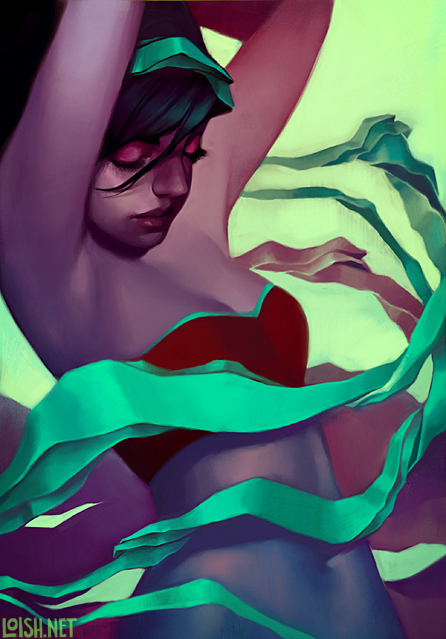
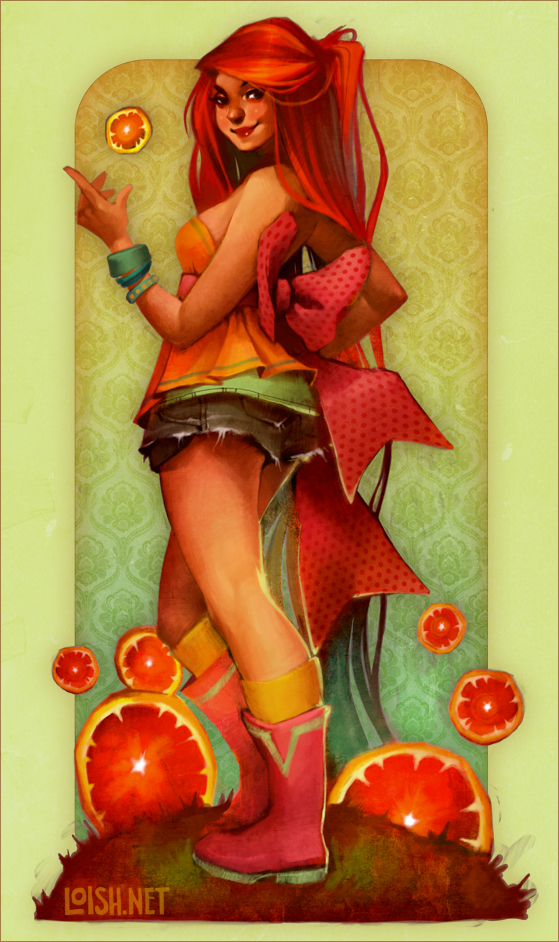
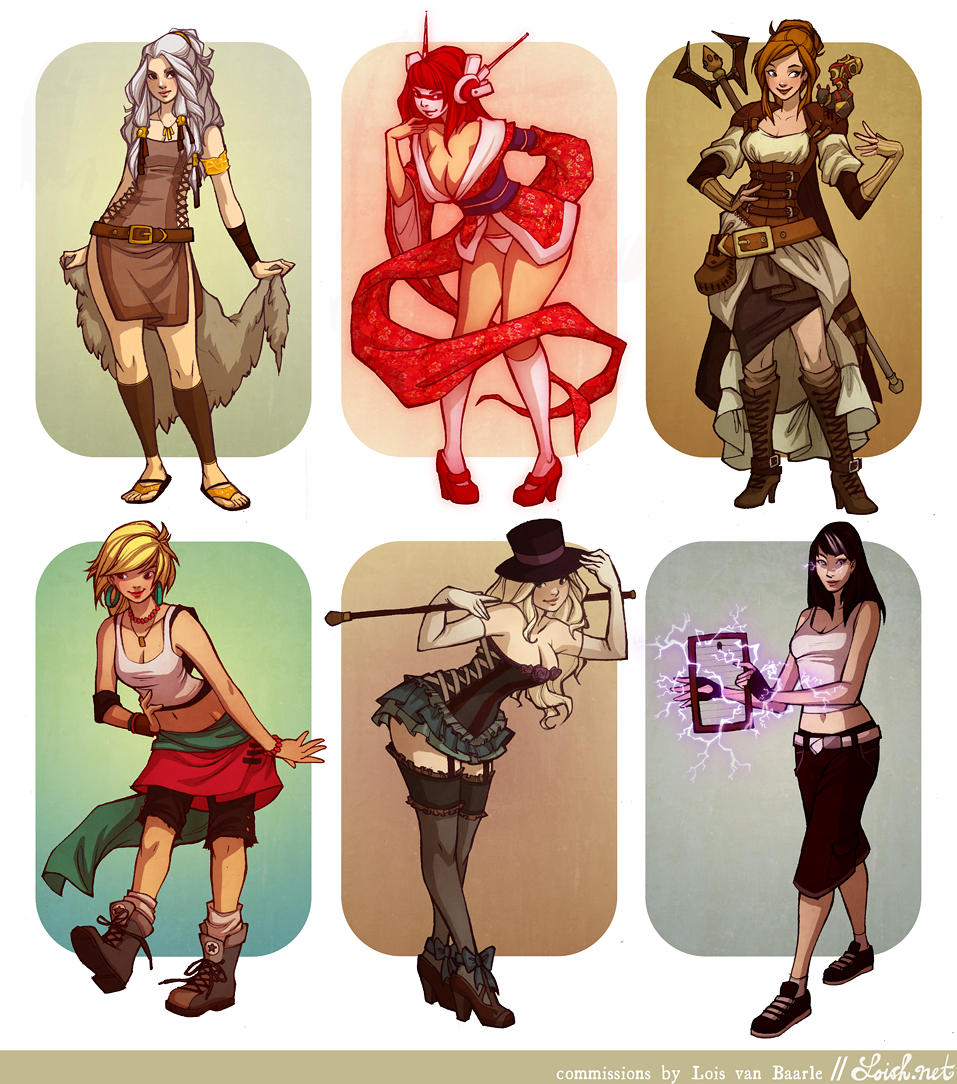
Loish is a fantastic illustrator/former animation student. Great character designs, beautiful colours, good anatomy, fluidity, these are just some of the things I like about this artist.


Her graduation animation:


Trichrome Blue from Lois van Baarle on Vimeo.

 Images and video belong to Lois van Baarle - http://loish.deviantart.com/

Kevin Bolk

''The Monochromatic Misadventures of Cartoonist Kevin Bolk'' - also known as ''I'm my own mascot'' is a series of comics by comic artists and illustrator Kevin Bolk. His satirical look at life and self-deprecating attitude make the comics not only fun but also well anchored in reality. His style may seem ''cute'' at first but I believe it does the job. Simple lines, simple colors, no shadows, make the comics easy to read and aesthetically pleasing.


Other comics by Kevin Bolk:


''It sucks to be Weegie!'' - making fun of the less loved brother of Mario


''Ensign Sue Must Die'' - parody of the Star Trek franchise


''Fair-Haired Adventure Seekers'' - Zelda parody


''Watchbabies'' - Watchmen parody


''Heeeere's Satan'' - no explanation needed


 Comics belong to Kevin Bolk - http://www.kevinbolk.com/

Phobs

One of the most interesting illustrators I have ever seen is the Russian deviant artist Phobs. His style blends dark humour with historical facts in a quirky yet charming style.

He mostly focuses his work on World War II historical figures:


Joseph and Magda Goebbels:


Heinrich Himmler:


Truman:


He also does comics:


In my opinion his strength lies in his use of varied facial expressions to make the characters come to life while his distinct style makes him stand out.


All images belong to Phobs - http://phobs.deviantart.com/

Thursday, 11 November 2010

History of Animation - Rotoscoping

'' Rotoscoping - animation technique in which animators trace over live-action film movement, frame by frame, for use in animated films.''

 This technique was invented by Max Fleischer around 1915. He first used it for the series ''Out of the Inkwell'' from which Koko the Clown was born.


  This method went on to be used in a number of animations including Betty Boop and Superman cartoons.      


   Walt Disney Studios used rotoscoping for a number of animated feature films including ''Snow White and the Seven Dwarfs ''.


    Even music videos have used rotoscoping to produce a sense of realism - ''Take on me'' - a-ha


  The same technique was used in the first three Star Wars films to create the lightsaber effects by creating a matte( combinations of two or more elements into a single, final image) based on sticks held by the actors.


  In the mid 90's, animator and computer scientist Bob Sabiston developed a rotoscoping software thus taking this technique to the modern era.

  As we can see, rotoscoping has been a vital part of animation for decades. Used in big budged animations as well as small budges ones, it has grown with the industry. Although it is a hard technique to master (inexperienced animators may cause the lines to shake unnaturally, or ''boil''), in the hands of a skilled animator it is a fantastic way to emulate life. It does lack the freedom one might associate with the visual arts field but it is an art form in its own right.


Thursday, 21 October 2010

Mike Inel - Draw with me


Mike Inel is a talented DeviantART artist. This is just one of his animations. His quirky style is a great contrast to the themes he chooses. These three minutes of animation manage to tell a story using no words while still retaining its depth.